Saturday, February 11, 2012

Gamegaddon: Metal Gear Solid 4

Breakfastman’s Gamegadon: Metal Gear Solid 4: Guns of the Patriots
It was supposed to be the end of one of the most beloved series of all time. It wasn’t, but is it any good regardless?
Metal Gear Solid 4 is a stealth-action game released in 2008 by Konami, and is the sixth in the “Metal Gear” series, which was started with the release of “Metal Gear” on the MSX2 15 years ago. My own experience with the series begins a bit more recently. A year or two back, I was in a used book store, browsing their used games shelve. I saw a copy of “Metal Gear Solid 2: Substance” for the original X-Box. I had always wanted to try the series, so I decided to purchase it. This turned out to be a great idea, and I quite enjoyed the game. About a month or so later, I purchased a copy of “Metal Gear Solid 3: Subsistence”. By the time I was finished, the game had become one of my favorite games on the PS2, and indeed, of all time. Unfortunately, it was not until recently that I finally managed to get a hold of a copy of MGS4, the game that marks the end to the series plot. Was it what I the epic end to the series I had hoped for? Kind of.

Metal Gear Solid 4 takes place five years after the previous game in the timeline, Metal Gear Solid 2 (Metal Gear Solid 3 being a prequel). Snake is rapidly aging because of his status as a clone, nanomachines are everywhere, and all parts of the world are in a state of constant war, with battles largely being fought by PMCs. The economy of the world is now intrinsically linked with war. Snake travels to the middle east to investigate reports of activity by creepy arm spirit possession man Liquid Ocelot. What he finds is that Liquid is testing a mysterious new weapon on soldiers. This starts a global race against time to find and stop Liquids plan for this weapon, hopefully saving the world in the progress. Snake meets many familiar characters along the way (in fact, anyone who wasn’t dead by the end of the previous games show up in some form or another), visiting a couple new environments, and meeting a couple of new characters along the way (only one of whom is any good).

            If you thought Metal Gear Solid did not have homoerotic undertones, well, have I got news for you!
 
The story is, to put it bluntly, pure Kojima, for better or worse. Yes, that does mean hideously bloated, way too long cutscenes, terribly overwritten dialog, an ending that goes for far longer than it should, unneeded characters that the game could have done without, and silliness. It also means tragic backstories, loads of great characters, a ton of good ideas (a lot of which actually work), and piles of memorable moments. It won’t win over anyone who hated the stories before, but for those who actually liked them, they will feel right at home.

This does not mean that everything is all sunshine and roses. There are still a few problems that seem to be unique to this game (or at least, pose much more of a problem in this game than in previous games). The main problem being that Kojima thinks the audience is a collection of idiots. There is also the issue of some awfully big plot-holes one could drive a truck through.

                    In game advertising does not get much more blatant than this.

Far too much time is devoted to explaining bits of history that I learned in highschool. This also happened in MGS3 (I know what happened in the Bay of Pigs, thank you very much), but it appears much more here. Yes, I do know what the cold war was. Thank you for explaining game. Oh wait, you want to explain the politics of the last 40 years? You do that. I am going to go get snack.

Too much time is also devoted to explain, in exhaustive detail, the events of previous games. This could have easily been accomplished with a “previously on MGS” option in the main menu that explained the events of the previous games (hell, they even have a mechanic that helps explain who characters are without interrupting the cutscenes), not the piles upon piles of cutscenes that we get in the game. They exhaustively detail every single plot twist, character arc, and relationship between the characters. It gets so damn distracting that I ended up tuning most of the dialog out, in order to avoid listening to characters explain to me things that I already experienced. They are distracting and break up the flow of the game considerably.

 Robotic tanks that walk around and two feet and moo. In case you couldn’t tell, this game can be a bit silly. Just a bit.

Far too much of the cutscenes are devoted to explaining things we have already figured out for ourselves. I cannot begin to count the times that a character revealed “startling revelation” that I had figured out at least a half hour prior. It is not even that I am incredibly smart and can spot twist a mile away (which I can, by the way); these twists are so screamingly obvious that the only way they could possibly be a surprise was if the player was high throughout the entire game.

Additionally, plot-holes. There are quite a bit of them. These are not small ones that one only realizes are there a week after when thinking about the game. No, these are “scream at your TV because it refuses to make sense” plot-holes. Multiple times characters make decisions that make absolutely no sense and do nothing but put their lives in danger when other alternatives exist that would not endanger their lives. Characters survive massive amounts of bullets, and characters that were pretty much dead as a doornail somehow manage to come back to life, then die a minute later, accomplishing nothing. It is all insanely distracting.

                                   Snake, morning the end of his relevance as a game character. :'(

But, every cloud has a silver lining; while there are stuff that outright craps all over the story, there are also many good ideas and interesting themes present. Chief among these themes is the theme of growing old. Since Snake is aging at an accelerated rate, he is now the physical age of a man well into his 70’s. He longs for the good old days, as seen in a later level of the game when sounds of his memories play in the background as he wanders around the area. He also suffers from “seizures” of a sort; these seizures really help to illustrate the pain that he is going through. Yet, the game never gets hopeless. Despite Snake’s age, he is still treated as an equal among his peers, and is even shown as being revered in a few circumstances. He is never seen as useless.

The game also has a rather heavy-handed anti-war message. Yet, despite how often the game bangs the player over the head with this (characters spout complaints about “the horrors of war” at every turn), it still manages to convey its message in some fairly interesting and subtle ways. Chief amongst these is the treatment of returning character, “Raiden”. In his youth, Raiden was a child soldier. This massively damaged his psyche, and as a result of that, he has a hard time connecting with people. He retreats from society to the only thing he knows: war. This has the effect of literally making him an inhuman killing machine. He is still seen as sympathetic; a man of unfortunate circumstances forced to become a monster because of forces beyond his control. Only when war has ended does he get his redemption, and the scene where he does is fairly poignant and moving.

                                   Nobody told Snake that you shouldn’t bring a knife to a gunfight.


The game uses a variety of interesting ways to tell its story and keep the player interacting. Every now and then, an “X” will appear in the corner of the screen; when pressed, this button shows a screen from previous game, reminding the player of the character/actions being mentioned. In the same vein, the player can sometimes press L1 to show the view from Snakes eyes. Additionally, there are other nice little touches, like well-placed quick-time events, some small deviations from the typical mode of gameplay, and other nice uses of interactivity to heighten the player’s involvement with the story. In light of this, it really is a shame that Kojima seemingly can’t recognize a good thing when he has it.

Unlike the story, the gameplay has received some fairly substantial improvements in this game. The MGS series never had the best gunplay. The player either had to shoot from a top-down camera with no way to aim, or go into first person, making it easier to aim but removed the ability to move. MGS4 changes all that. The player can now fire down over the soldier, or aim down the sites at will. The game also allows the player to move and shoot at the same time. The ability to move while crouched or take cover behind walls is also added, and both are a god-send and improve the gunplay substantially. It is finally fun to shoot enemies in the face, and blows every other game in the series out of the water.

The tranq gun makes its triumphant return. Unfortunately, it has limited ammo, so no more acting like the sandman.


The camera has also seen a big change. Instead of the terrible, isometric top-down camera that nearly every single other game except the special addition of 3 had, they implement a camera that is controlled by the player. The player can now use the right-thumb stick to move the camera and look at whatever they so desire, without having to bother to go into first-person. This gives the action and the stealth a kick in the pants and change the way the player plays both.

The control scheme has received a number of improvements, but it is still not good enough to call it “good”. The player no longer uses the Codec to save, which is nice. But, the terrible inventory system from the previous games is still present. Pressing L2 and R2 bring up the item and weapon inventory respectively, and the player can flip through the selections on the screen. This has the unfortunate effect of breaking up the action whenever the player wants to use a health item or change to another weapon. It would have been easier to let the player map favorite weapons/items to hotkeys, but no such luck. Drawing a weapon with L1 and firing with R1 feels fine, but having to hit Triangle to go into first person feels sloppy. Crouching and going prone with X also feels fine, but if the player wants to roll while moving, God help them. Too often I found myself trying to roll away from danger, only to go prone or crouch at the end of the roll. Stuff like that should not happen; I should not be doing things I did not mean to do, through no fault of my own.

                                                                Eh, Snake can take them, I think.


The game includes a new item customization system. The player can attach a variety of sights, silencers, flashlights, laser pointers, grenade launchers, shotguns, and more to most of the weapons. These changes not only show up on the guns in game (a nice aesthetic touch), but make a huge difference in how they work and how the player can use them. I ended up converting an M4 given to me in game into a silent bringer of death on par with my sniper rifle. This was probably my favorite new feature of the game, and it is implemented superbly.

A new shop system is also implemented. When wandering around the battlefield, Snake will pick up new weapons, the first version of which is kept, and all subsequent pickups are sold to the shop for points. These points can be used to unlock weapons (since the weapons Snake pick up on the field are locked for a certain individual and cannot be used immediately), or to purchase new weapons, items, ammo, or upgrades. The player will never want for points either, since enemies drop weapons whenever they die, and each weapon gives a rather large amount of points. I had over one hundred thousand by the end of the game, and had all the weapons, ammo, items, and upgrades I could ever want.

                                                                        Most useless. Metal Gear. Ever.


Stealth is much less of a focus in this game. Oh, don’t get me wrong; it is still a stealth game and stealth is still a viable option. It just so happens that blowing away enemies is also a viable option. The ultimate result of this is that the player has more options than ever. They can snipe enemies from afar, sneak around without killing anyone (and if they do get caught, they can fight their way out), or run in guns blazing. The end result is a game that offers more options than previous iterations and is more satisfying than ever, whether capping fools with a sniper rifle, sneaking behind enemies’ backs, or killing the hell out of everything that moves.

A MGS game would not be complete without memorable boss battles, and this game delivers, most of the time. All bosses are every different, both in tactics and overall appearance. Problem solving skills are still as important as they ever where; the player needs to be just as clever as they are aggressive to take them down, since many bosses have a trick to fighting them that is not always immediately obvious. I really don’t want to talk any more about them than that, since half the fun of every MGS game is the unique bosses that get thrown at the player.

                                     Someone is in for a load of pain. Hint: it is not guy pressed against the wall. 


While the gameplay is fantastic, the graphics in the game are good, but nothing special. There is a bit of nice texture work, everything animates beautifully, and the foliage and hair effects are nice, but nothing really stood out. The character models all look incredibly unrealistic, but it does not really clash with the rest of the game since it was not going for realism to begin with (the presence of giant walking tanks that can swim through the water pretty much destroys any hope for realism one might have had). The game does feature some absolutely brilliant use of particle effects that really help to make the game look nice.

The level design is also nice, but nothing special and frequently has problems. The first two levels offer the player many ways to approach a situation, but they don’t look that different from each other. The third level has an interesting premise and looks really neat, but it pretty much abandons much of what it had going for it after about a half hour. The 4th level is also good, but does not have nearly enough gameplay. The final level has about as little actual gameplay as possible. Additionally, the game never stays in one place long enough for the player to get acquainted with it, unlike the previous games, which certainly don’t help. It is not up to the high standards set by the previous game.

                                 Snake’s favorite past-time: blowing stuff up. Hey, a man’s gotta have a hobby.


Metal Gear Solid 4 is a solid entry in the series, but not the best. The story has a lot of good ideas, many of which work, but ends up being too hampered by a ton of terrible decisions. The gameplay has certainly received a bump in quality, resulting in gunplay and stealth that is more satisfying than ever. Metal Gear Solid fans will probably enjoy the game, and those who couldn’t stand the gameplay from previous entries in the series should check this one out. Anyone who didn’t like the others for the story shouldn’t bother. I would also not recommend this one to anyone looking to get into the series either; if you really want to get into the series, play MGS3: Subsistence.


Breakfastman is an amateur reviewer, student, and all around cool guy. Questions, comments, constructive criticisms, rants, rages? Feel free to post them below. All images blatantly stolen from Google.

Saturday, January 21, 2012

Gamegaddon: Dead Space 2.

I have resurrected my blog. Hurray!


Breakfastman’s Gamegadon: Dead Space 2
It is Uncharted meets the original Dead Space. But is that a good thing?
Note: This review is of the PC version of Dead Space 2. The entire game was played with the X-Box 360 gamepad.

Dead Space 2 is the sequel to 2008's Dead Space (duh). I played the original about a year or two ago, and really liked it. It had some great gameplay mechanics (the zero-g segments being among the most memorable), looked fantastic, and had a great atmosphere. It was not particularly scary, nor was it the most unique take on the survival horror genre (it took its fair share of gameplay mechanics from Resident Evil 4, and borrowed more than a few elements from The Thing, Event Horizon, and Alien), but it was an enjoyable and fairly interesting take on the genre nonetheless. So when the sequel was announced, I was interested and excited to see where Visceral Games would take the series. What I got was something that I did not I expect.

Dead Space 2 takes place sometime after the first game (it is unclear exactly how much time has passed between games, but it is implied of being upwards of a year). Isaac Clarke, the protagonist of the first game, has been driven mad by the events that occurred aboard the starship Ishimura (the location of most of the first game) and is being kept in an asylum aboard "The Sprawl", a space station created around the shards of Saturn's moon Titan. He awakens from his insanity at about the same time the Necromorphs, the hideous mutated humans that served as antagonists in the first game, attack the Sprawl. Isaac has to, once again, fight his way through the massive hoards of Necromorphs and figure out what caused the outbreak on the station. Along the way he meets a fellow asylum inmate that seems to know more than he will tell, a plucky pilot who is also trying to escape the sprawl, more Scientologists Unitoligists, and the space station administrator who wants Isaac dead for some reason.
                                                    Isaac knew he should have cleaned out his refrigerator sooner.

The story has potential, but most of it is pretty much wasted. Interesting plot threads and questions are introduced and left unresolved, which is very frustrating. The reason for unleashing the Necromorphs makes little sense and leaves too many questions. The Unitologists are given nothing interesting to do at all. The side characters are okay, but don't really have anything interesting to do or say beyond basic exposition and cryptic riddles. The motivations of the villains are never well explained, and the explanations given make very little sense. The plot itself follows the same basic structure of the first game: someone telling the player over the intercom to go here and fix that so they can make a modicum of progress to their goal. It is like the door quests from Half Life 2 stretched out to fill an entire game.

Making a character who was basically a "Gordon Freeman" in the first game into a fully voiced character with an actual personality seems like a mistake (it sure as hell didn't work for Other M), but it turns out much better than one would think. He never gets annoying or seems like he is whining. He is caring, empathetic, and helpful. He tries to save everyone he can, but he does not always succeed. He makes sacrifices to try and save all the people he can. Despite a few strange out of character moments (one near the end of the game that involves a gaggle of security guards and hoards of Necromorphs sticks out in my mind), his character is handled decently, and even has a number of interesting sub-plots.

Unfortunately, nearly all the sub-plots that involve Isaac's character are not as explored as well as they could be, and end up disappointing. There is some exploration of Isaac's guilt over getting his girlfriend to join the crew of the Ishimura, but none of it is resolved in any interesting way or given the full treatment it deserves. The game devotes a few moments to exploring the PTSD that Isaac acquired from the events of the first game, but like his guilt, is never given the proper attention to be anything more than a curiosity. The game seems to suggest at the beginning and the end of the game that this is all taking place inside Isaac's head and is his way of coping with the horror of the events in the first game, but given how the rest of the game plays out, I doubt this was at all intentional. It seems like the designers had a lot of good ideas for the Isaac's character, but did not have any idea on how to get it across. The game would have greatly benefited from having an actual writer on staff.
                                       A typical day in a Scientology church. Dietetics does weird stuff to you, man.

While the story may suffer, the gameplay does not. The main point of the game is to kill Necromorphs. The easiest and most effective way to do so is dismember them. Blowing off a Necromorph's legs and arms kills them much faster than just shooting them in the chest until they go down. To help the player outdo Jason Voorhees in their quest to mutilate as many creatures as they can, as fast as they can, a number of fun tools/weapons are provided. There is the Ripper, which functions like a buzz saw the can shoot saw blades at long range, the Javelin Launcher, which can impale monsters and then electrocute them, and the Line Gun, which takes out Necromorph legs better than nearly everything else. The player also gets a couple of useful powers. One, called "Kinesis", allow them to pick up and throw things, Gravity Gun style. The other, called "Stasis", slows down enemies so the player can dismember them easier. All the weapons and powers are fun and satisfying to use. Shooting out the legs of an advancing Necromorph, impaling it to the ground, then electrocuting it never gets old and is incredibly satisfying.

The player can also upgrade their weapons, armor, and powers with "power nodes" found scattered throughout the station. These items are fairly rare, so the player has to be very careful with what upgrades they do choose, making any upgrades they do choose more meaningful. There is a shop the player can purchase weapons, armor, ammo, health packs and nodes from, using currency found in the station or from dead enemies. They can also sell back or store unneeded health, ammo, or vendor trash and turn in any schematics found in the station to unlock better armor, health packs, ammo, and more guns.

The controls themselves work well. It is structured pretty much the same as Resident Evil 4, but with a few notable improvements. First, movement ditches the horrid tank-esque controls of Resi 4 for a more traditional, action game approach (e.g. pushing right makes Isaac move right, pushing left makes Isaac move left, etc.), which is a massive improvement in my book. The player is also allowed to move and shoot at the same time, which is also a great improvement. They can assign up to 4 weapons to quickslots on the D-Pad, press "B" when not aiming to use a healing item, or press "Y" to use an item that restores stasis power. All this results in spending more time in the game than the menu, having fun instead of raging about crappy controls because the player character cannot figure out that it is possible to move and shoot at the same time.
                                   What most people think teaching kindergarten looks like. Hint: It is actually worse.

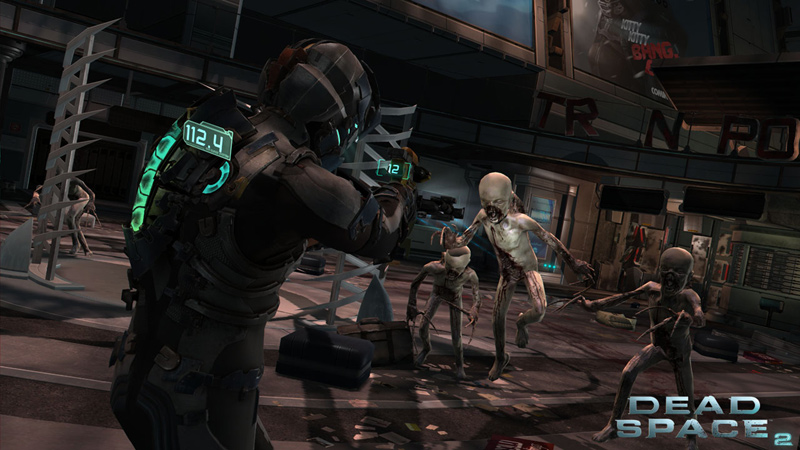
The UI also deserves praise. Instead of following the regular, tired game route of having all the HUD items pasted on the screen like stickers, the game places all the usual HUD and UI elements onto the protagonist himself. His health bar is displayed on his back, the ammo count is displayed as a hologram on his weapon, the targeting reticule is displayed as a laser pointer coming out from his currently equipped item, the inventory and objective menu is displayed as a hologram projected from his suit in front of his body, and the objective marker is displayed as a hologram projected from his hand onto the floor. The store inventory and the upgrade bench's menu are displayed as a hologram projected from the front of a kiosk/bench. It is all very cleverly done and feels very natural in the context of the game world, something which most games should aspire too.

In addition, the game features some absolutely stunning level design. There are times where I just had to stop and stare in awe at what I was seeing. From racing after a train in nothing but a spacesuit to sky diving from a satellite unto the station, the game features some spectacular moments and amazing vistas. All the levels are perfectly paced, stringing together moments of tense combat with moments of quiet, zero-g puzzle solving. It all works together quite well and I never felt bored. There was always some interesting new environment or some fun new set-piece moment. It kept me going to see what they were going to do next and what awesome new sight was just beyond the corner.

The great sound design is worth a mention as well. All the monsters sound creepy, making all sorts of gurgles and terrible screams. The weapons sound real, and the squish they make against the flesh of the monster sounds convincing enough. The muted sounds during the space-walking elements are especially convincing, helping to draw the player into the mind that they really are floating around in space.

 Damnit, Isaac, I told you to shoot it’s weak spot for massive damage! Not to face the opposite direction and let it kill you!

Unfortunately, the fantastic set-pieces tie into one of my main complaints: the game just is not scary or subtle enough. Yes, the first game was not on par with Blair Witch Project it terms of subtle horror, nor did it lack its share of spectacular views and epic moments, but this game makes Dead Space 1 look like Silent Hill 2 in comparison. There are a number of the moments where the game seems to be banging the player over the head with its gore and jump scares, saying stuff like "OMG, THAT BABY JUST EXPLODED!!! ISN'T THAT GRUESOME? BOY, THAT SURE IS SCARY, HUH? BE SCARED DAMNIT, BE SCARED!!!" Sure, there are a few good moments here and there where the game decides to slow down, but they are few and far between. The game never gives the player enough time to really get into the atmosphere; it instead tries to distract the player at every opportunity with a shiny new set-piece gruesome new monster. It is like the developers are not confident in their ability to scare the player, so they opt to distract the player instead of trying to make him/her fearful.

Dead Space 2 also suffers from being overly linear, especially when compared with its predecessor. In Dead Space 1, the player was often dumped into an environment that had multiple paths and areas to explore. Yes, this resulted in a lot of back tracking, but it also allowed the player to get more into the atmosphere and made the ship feel more like a real place. It also allowed the developers an easy way to scare the player by placing monsters in already cleared rooms to induce surprise and panic in the player. Not so with Dead Space 2. The game is entirely linear, with nary a branching path or moment of exploration to be found. This really does not work in the game favor. It makes the Sprawl feel less like a real place and more like a Halloween fun house, which is a massive no-no for any horror game. The developers also lose an easy and effective way to scare the player and build atmosphere in the process. Linearity is fine in a horror game when it is done well and is coupled with a sense of subtlety. Dead Space 2 lacks that subtlety, which, when combined with the linear nature of the game, makes it feel more like Uncharted than the original Dead Space.

                                                         Chest vaginas: In the running for the worst idea ever.

In the end, Dead Space 2 is a fantastic action game with horror elements, despite the story problems. If you are looking for a good survival horror game or horror game with action elements, stay far away. If you just want great, gory combat with pretty environments and great level design, look this one up. I can't say I expected the series to go in this direction, nor can I say that I liked that it is going in this direction. I did enjoy the game as an action game, for what it is worth.


Breakfastman is an incredibly professional reviewer, and all around cool guy. Questions, comments, constructive criticisms, rants, rages? Feel free to post them below. All images blatantly stolen from Google images.

Friday, September 2, 2011

Movie Time: Bubba Ho-tep

Movie Time with Breakfastman: Bubba Ho-Tep


Bubba Ho-tep is a black comedy/drama movie based on a novella by Joe R. Landsdale, and adapted for film and directed by Don Coscarelli, otherwise known as the man behind the Phantasm movies and the first Beastmaster movie, but not much else. While I have not seen anything of The Beastmaster beyond Spoony's review of the film, I have seen the first Phantasm movie, and I frakin' loved it. It was gloriously cheesy, campy, weird, and just plain fun. It was one of my favorite horror films of the 70's (beaten out only by the original Halloween), and is an incredibly underrated cult classic. If you haven't watched it, do so immediately. Go on, I'll wait. Okay, finished? Awesome movie, wasn't it? Well, what if I told you that the man responsible for that movie created a movie where an elderly Elvis, played by Bruce frellin' Campbell himself, and an elderly John F. Kennedy, played by Ossie Davis, fought a mummy that dresses up like a cowboy and eats souls in a rest home? You would want to know what that movie was called, right? Well, look up. We are talking about that movie today. This is Bubba Ho-tep.

                                         Bruce Campbell as Elvis. I am pretty sure someone's argument is invalid.

The film starts out in the Shady Rest retirement home, the camera panning through the yard outside, the hallways lined with rooms inside before we finally see Bruce as Elvis, lying in a bed, asleep. We then hear him thinking about his penis, which becomes a bit of a running gag in this movie. He then wakes up to the sound of his roommate coughing. He tries sees if he is okay, but as it turns out, he is not. He, in fact, dies in front of his eyes. After his body is taken away by two bumbling undertakers (another running gag), we see another old woman, wandering through the halls of the home, stealing anything that looks interesting. She makes off with a box of chocolates, and proceeds to eat them in her room. A scarab comes out of the box of chocolates (I think it came out of the box anyway), and proceeds to attack here. She manages to attack it back with here cane, but the little bugger is persistent. She is then attacked by a mummy in a cowboy who suddenly appears in a corner of the room. We then switch back to Elvis to see the old woman hanging onto the door for dear life, whispering "help me". She then gets dragged of. Elvis, confused, goes back to sleep. The next day, the two bumbling undertakers return to take the old ladies body away, and we see that a young female relative of Elvis's old roommate has come to take care of his things.

                              Excuse me, I seem to be lost. Can you please direct me to the set of The Mummy Returns?

Elvis strikes up a conversation with the girl about his old roommate, and tells her his sad story. You see, it turns out he is the real Elvis. In a desire to escape the pressures of fame and super-stardom, he decided to switch places with an Elvis impersonator, for who better to impersonate Elvis than someone who does it for a living, eh? Anyway, he made a contract with the impersonator that he can switch back anytime he wants. Unfortunately, his side of the contract was destroyed in a trailer park fire. He didn't care though. He loved his new life. Unfortunately, one day while performing, he fell and broke his hip, in addition to going into a coma for 20 years. She obviously doesn't believe him and writes him off as a wacko (which he just might be. The film never makes it quite clear whether he is or not). That night, he too is attacked by the same bug, but manages to kill the thing by stabbing it with a fork and shoving it into an electric heater. After that happens, he wanders into the hall to inform the workers that they have a massive bug problem. He wanders into the room of his friend, Jack, who thinks he is John F. Kennedy. He finds him on the floor, and summons the orderlies. The next night, Jack comes to his room and informs him of a strange find. Jack shows him writing in Egyptian on the bathroom wall, and insists it is a sign that they are being stalked by a soul sucking mummy. Elvis doesn't believe him until he sees the mummy himself. He and Jack then take it into their own hands to defeat this mummy and save the souls of all who live in the rest home. The plot proceeds as expected, but it was well paced enough to keep my interest through it's entire runtime.

                                                     Bruce Campbell fighting a mummy with a walker. Awesome.


What is the most surprising about this movie is how understated the whole thing is. I know that sounds odd talking about a movie where Elvis lights a cowboy mummy on fire, but it really is. It is much more of a character study than anything. The parts with the mummy feel almost incidental. Both of the main characters, Jack and Elvis, despite how crazy or crass they act, are always portrayed with a strange sort of dignity and respect. They reminisce former glories, contemplate old grudges, and talk about lost chances. Their is very little that is over-the-top about their characters, surprisingly enough, and both actors who portray them put in strong performances, Campbell especially. While one might think that he might flounder when is out of his element, he actually performs wonderfully, making his character, an aging (and possibly dying) Elvis, all that more believable. The entire film itself is, in essence, about the realities of aging and how the elderly are treated. It really is quite extraordinary how well written and deep a film like this is. It shows that you can make a great film with real depth about nearly anything.

While very odd, this is still not the strangest thing I have seen in a movie. That award still goes to the entirety of Eraserhead. David Lynch, you crazy man you.

The rest of the movie holds up pretty well. The music is what you would expect, lots of southern twang and Elvis sound-a-likes. The plot does have some holes here and there, but none of them really hampered my enjoyment of the film. The cinematography is excellent, and really helps to add to the atmosphere of both melancholy and claustrophobia that seems to be present throughout the film. The writing is generally good, except for the aforementioned plotholes, and the jokes are generally funny.

                                                              *Insert "DAT ASS" joke here*

TL;DR:

Bubba Ho-Tep is a very strange film. Yet, surprisingly enough, it works, and it works well. The characters are interesting, the principal actors do a great job, and the plot is surprisingly deep. It might have some problems with the plot here and there, but that doesn't stop it from being an enjoyable, memorable film. If you have the opportunity to see, I say go for it. I doubt you will regret it.


-Breakfastman out.